Research
I study the gas, stars, and dust in and around galaxy clusters across the whole electromagnetic spectrum! Click the dropdown links to learn more.
Background
A short overview on what I study. What are galaxy clusters? What is the cooling flow problem?
Background
A short overview on what I study. What are galaxy clusters? What is the cooling flow problem?
Galaxy clusters are collections of 100s-1000s of galaxies and are the largest gravitationally bound structures in the universe. Each galaxy cluster hosts a massive galaxy at its gravitational center, simply referred as the central or brightest cluster galaxy.
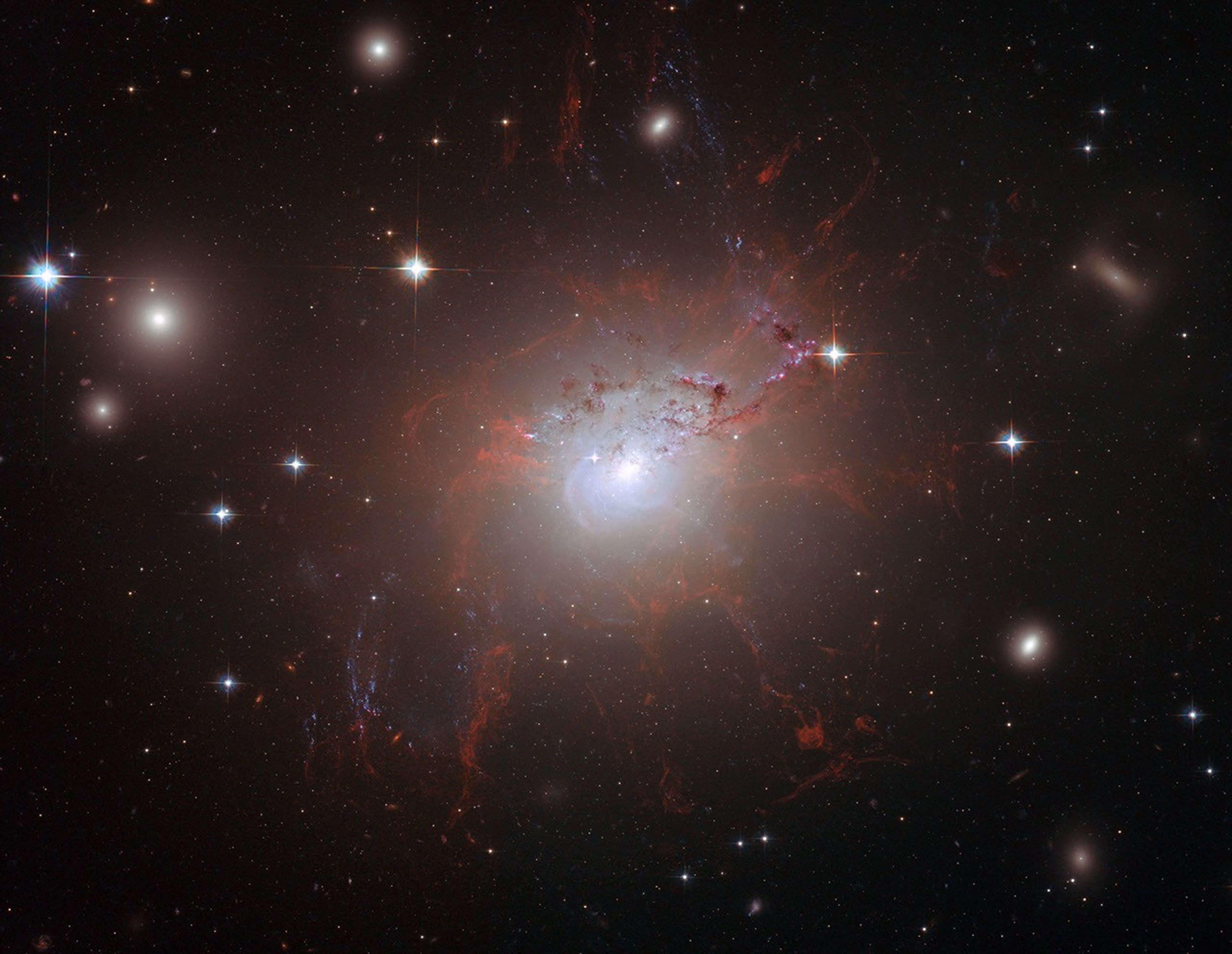
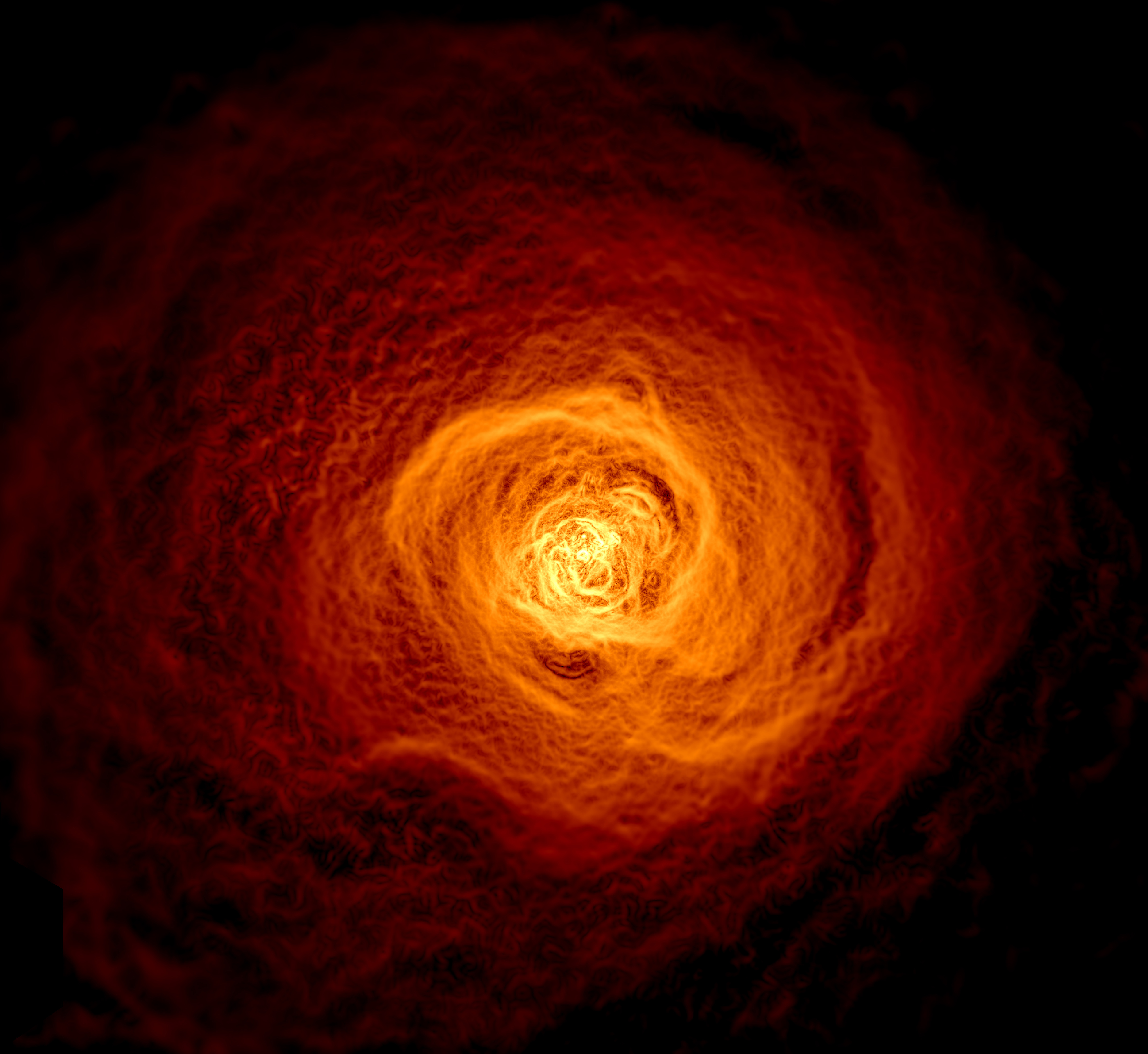
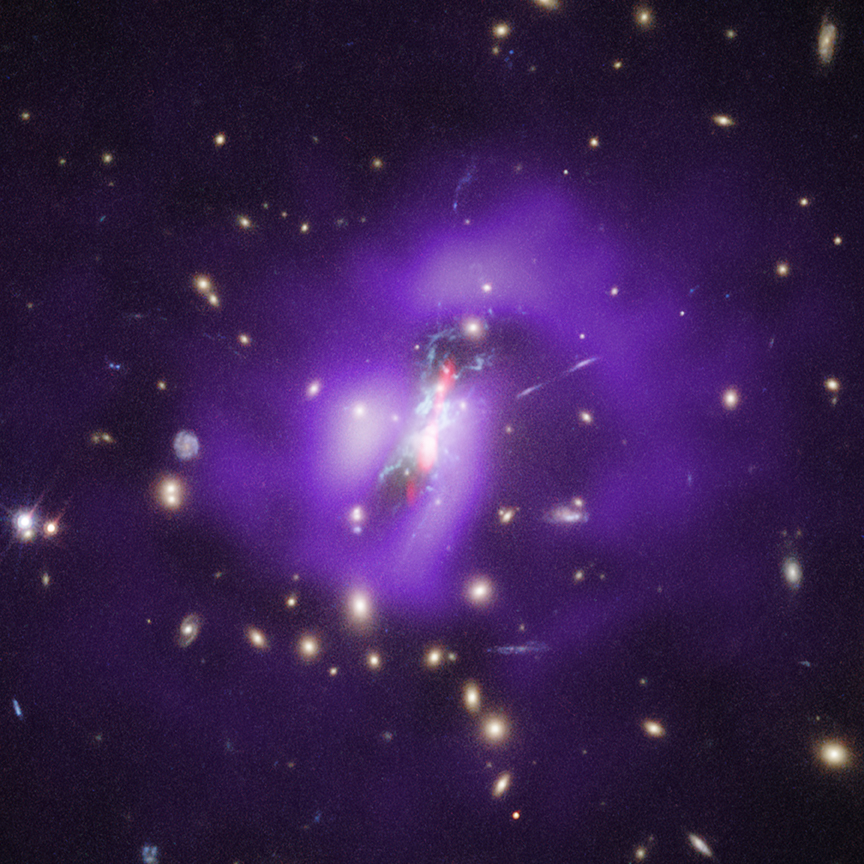
These are some of the most massive galaxies in the known Universe, as they are the result of many generations of smaller galaxies merging and being eaten up by the central galaxy. But the stars and galaxies in the cluster only contain a small fraction of the cluster's luminous mass: less than 10%. The other 90% is attributed to the gas and dust between the galaxies in the cluster, called the intracluster medium, or ICM. The ICM is incredibly hot (10 million Kelvin) and diffuse (less than 1 particle per 10 cubic centimeters), both of which make it hard for it to cool down efficiently. However, the ICM tends to get cooler and more dense towards the center of the cluster, and in some clusters where this effect is pronounced, we expect to see the gas cooling down, condensing, and falling inwards towards the cluster's central galaxy, fueling star formation. Nevertheless, what we actually observe is that the gas does begin to cool out of the hot X-ray emitting phase, but it never makes it to the cold molecular phase to fuel star formation. Evidently, at some point, the gas either vanishes completely, or is being reheated by some mechanism. This is known as the cooling flow problem.
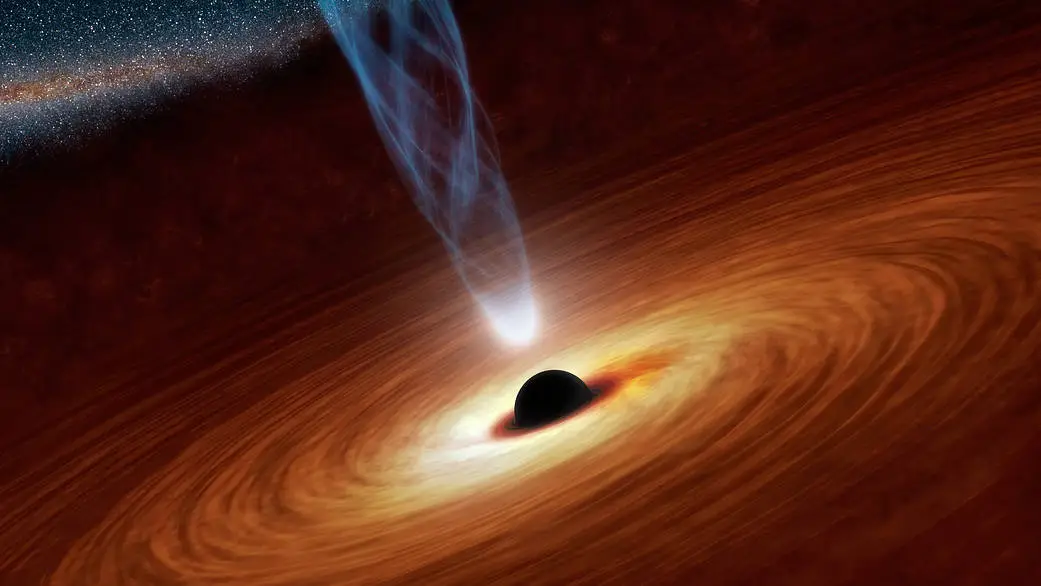
There are a number of theories that have been proposed to try to explain these counterintuitive results. Many researchers think that an Active Galactic Nucleus, or AGN, is to blame for reheating and disturbing the ICM, preventing it from forming stars. An AGN is composed of a supermassive black hole at the center of a galaxy surrounded by a disk of hot gas and dust that is swirling around and feeding into the black hole.
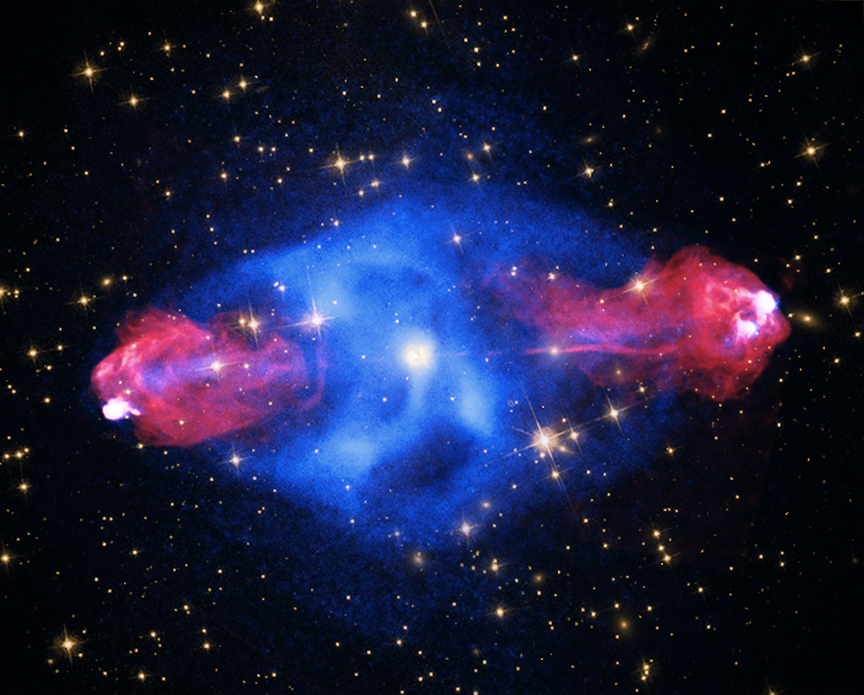
These are some of the most extreme objects in the Universe, and they can produce strong outbursts, winds, and radio jets (collectively referred to as "feedback") that all may contribute to stirring and heating up the surrounding gas in their host galaxy. This makes them a promising candidate for resolving the cooling flow problem, but many questions still remain unanswered. For example, we still don't know how quickly feedback from an AGN is able to start balancing with the cooling gas, how this feedback can efficiently prevent cooling throughout the entire central volume of a cluster, and how this balance evolves over time and over cosmic history. There are also alternate theories that propose that there is actually a large amount of gas that is able to cool (at least partially), but we are just unable to see it because the X-ray emission from this cooling gas gets heavily absorbed by cold clouds of gas and dust before it reaches us.
My Research: The Cooling Rainbow
An overview of the techniques I use in my own research to study galaxy clusters and cooling.
My Research: The Cooling Rainbow
An overview of the techniques I use in my own research to study galaxy clusters and cooling.
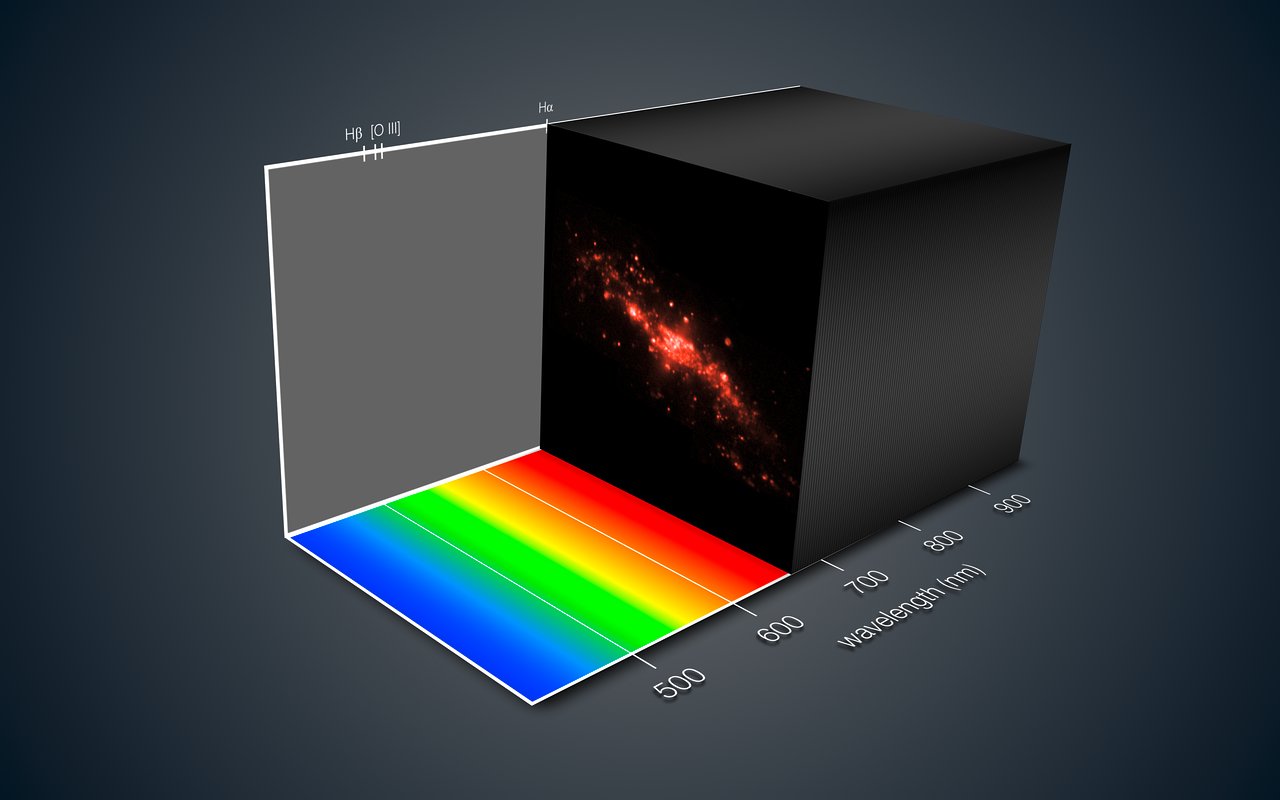
My current research focuses on multiwavelength studies of the intracluster medium to try to better understand the properties of the ICM, the cooling flow problem, AGN feedback, and galaxy cluster evolution. A big part of my work uses integral field unit (IFU) spectroscopy, which is a revolutionary technique that enables us to obtain spatial and spectroscopic information simultaneously. IFU instruments produce 3-dimensional "cubes" of data: You can think of this like a series of 2D images, each measuring slightly different wavelengths of light, all stacked on top of each other. Or, you can think of it as single image, but each "pixel" in your image is actually an entire spectrum! This dramatically increases the amount of information we can obtain about a galaxy or cluster of galaxies by allowing us to resolve many spectral features (i.e. continuum luminosities and slopes, gas emission lines, dust absorption and emission features, etc.) and map them out spatially all at the same time.
I have been targeting so-called "coronal" emission lines, which are spectral features which require very high energies (ionization potentials above 90 eV) to produce. These lines are most sensitive to cooling gas at temperatures of 100,000s of Kelvin, so they are particularly helpful in mapping out the ICM at intermediate temperatures between the hot X-ray phase at 10 million Kelvin and the cold molecular phase at 10 Kelvin, revealing what happens to the gas as it is actually in the process of cooling down. This is essentially the "smoking gun" of cooling gas in galaxy clusters!
I have used world-class instrumentation with NASA's JWST mission in the infrared, HST in the UV/optical, and FUSE in the UV, to measure these coronal lines and map out cooling gas in galaxy clusters. To learn more, check out my publications here.
Interactive Cooling Demo
See a simulated parcel of gas cool in real time and watch how the cooling function, observed surface brightness, and observed spectrum change.
Interactive Cooling Demo
See a simulated parcel of gas cool in real time and watch how the cooling function, observed surface brightness, and observed spectrum change.